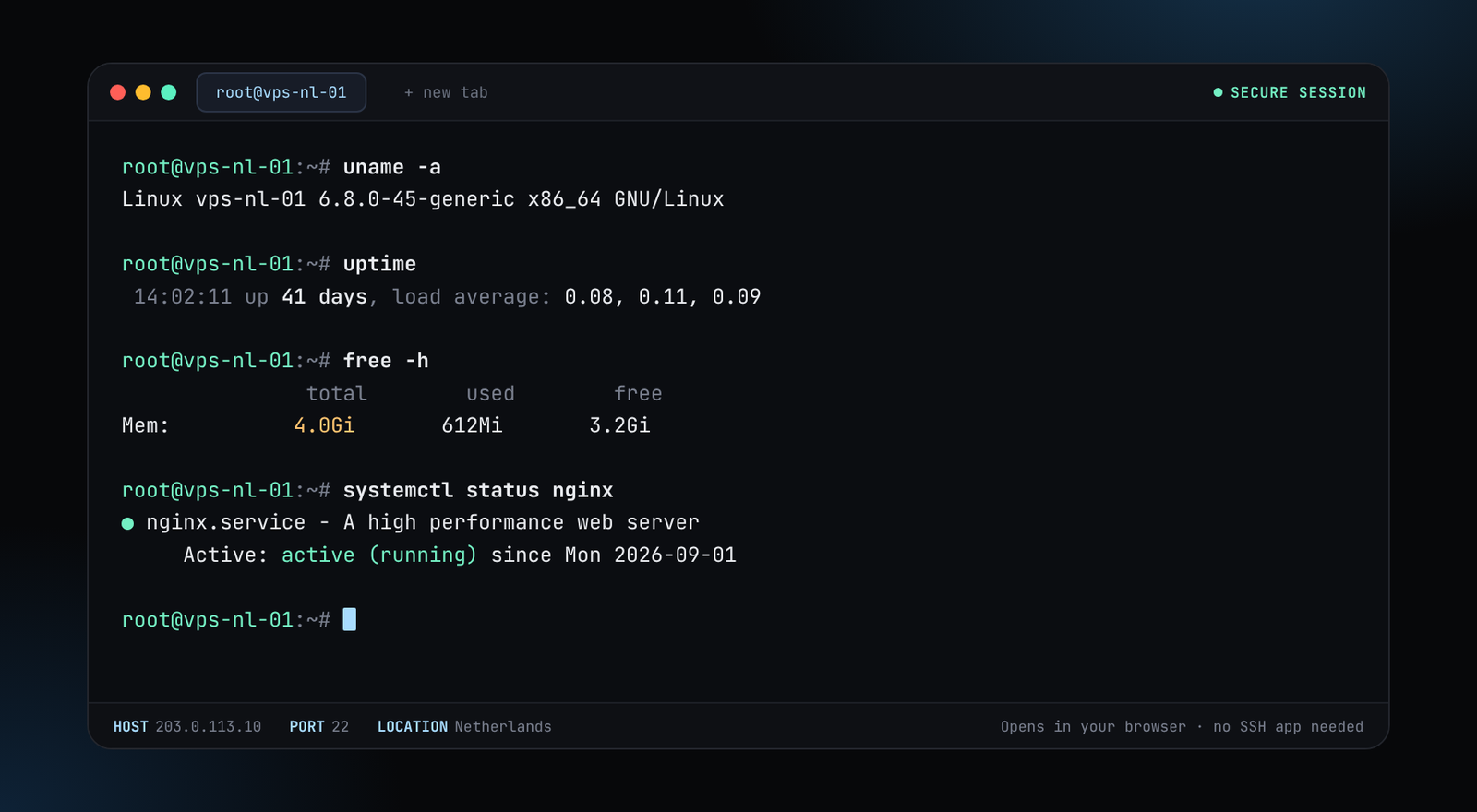
We've got a new update. We now offer our own Web Console. Open the console and type ssh root@your-server-ip to reach any server you own, right from your browser. No SSH app needed.
Most people who say they need a TRON node need a Lite FullNode, which starts from a snapshot of a few dozen gigabytes. If you need deep history, the full chain is about 3 TB and wants a dedicated server. Lite from $28 a month, full history from $140.


Prices are for Romania on a one-month term; a 12-month term takes 50% off.
or $14/mo on a 12-month term (−50%)
Starts from a state snapshot (tens of GB) instead of replaying the chain. Serves current state, not deep history.
Configure and orderor $70/mo on a 12-month term (−50%)
The full-history chain is about 3 TB, more than any single drive here, so you stripe two or more drives into one volume.
Configure and orderBoth run the same java-tron client. The difference is how much data they start with.
A Lite FullNode boots from a state snapshot that contains the current state and the most recent 65,536 blocks, about 54 hours. TRON’s own documentation puts that snapshot at roughly 52 GB in May 2026, a few percent of a full-history snapshot. Historical-query APIs are disabled by default. It is the right choice for a wallet backend, a payment checkout that watches addresses, or a bot that sends transactions. Third-party guides recommend 300 to 500 GB of NVMe so the data can grow, 8 to 16 cores and 16 to 32 GB of RAM, which is why we offer an 8 vCPU, 32 GB, 400 GB VPS for it.
This one stores the whole chain from genesis, or boots from a full snapshot. The official snapshot was about 3 TB in May 2026, and a guide updated for 2026 suggests planning for 4 TB. Block explorers, indexers and Super Representatives run it because they answer historical queries. It needs 16 cores and 32 GB of RAM at the least.
No single drive in our dedicated range holds 3 TB (the biggest is 4 TB on the X-Large; the Large has four 2 TB drives), so on the Large you stripe two or more drives into one volume with LVM or software RAID 0. That has no redundancy, so keep the snapshot source handy. For more headroom, the X-Large has four 4 TB drives.
You may see a Lite node quoted at 1.3 TB. TRON’s own figures for a Lite snapshot are in the tens of gigabytes. If a quote asks you for terabytes to run a Lite node, check it against the source below.
| Lite FullNode | Full-history FullNode | |
|---|---|---|
| Starting snapshot | ~52 GB (May 2026) | ~3 TB (May 2026) |
| Disk to plan for | 300 to 500 GB NVMe | 4 TB |
| History queries | Disabled by default | Yes |
| CPU and RAM | 8 to 16 cores, 16 to 32 GB | 16 cores, 32 GB or more |
| Typical use | Wallets, checkouts, bots | Explorers, indexers, SR nodes |
| Build here | 8 vCPU · 32 GB · 400 GB VPS | Dedicated Large, striped drives |
| Price here (Romania, 1 month) | $28 | $140 |
Download FullNode.jar and main_net_config.conf from the official java-tron repository and read its release notes for the supported Java version before you start.
java -Xmx24g -jar FullNode.jar -c main_net_config.conf
# For a Lite FullNode, extract the Lite snapshot into the output directory firstsudo ufw allow 18888 # peer-to-peer (TCP and UDP)
# 8090 (HTTP) and 50051 (gRPC) are APIs: expose them only to your own applicationThe official full-history snapshot was about 3 TB in May 2026, and third-party guides advise planning for 4 TB. A Lite FullNode starts from a snapshot of about 52 GB.
It is a java-tron node that boots from a snapshot of the current state plus the latest 65,536 blocks (about 54 hours) instead of replaying the whole chain. Historical-query APIs are disabled by default, so it suits wallets, payment checkouts and bots rather than explorers.
A Lite FullNode, yes: our 8 vCPU, 32 GB, 400 GB NVMe VPS is $28 a month. A full-history node does not fit on a VPS because the chain is about 3 TB and our largest VPS disk is 1 TB.
Guides recommend 16 to 32 GB for a Lite FullNode and 32 GB or more for a full-history node, and 8 to 16 cores. A node that produces blocks needs more.
Port 18888 for peers, 8090 for the HTTP API and 50051 for gRPC by default. Open 18888 for peers and expose the APIs only to your own application.
Yes. TRC-20 USDT is one of the cheapest ways to pay: top up through the native checkout and deploy. See TRC-20 vs ERC-20 for hosting payments.
No. You create an account with a generated login and need no ID, card or phone number. You remain responsible for what you run under our terms.
Checked 19 October 2026. Chain sizes and software requirements change, so confirm against the source before you order.
Choose Lite on a VPS or full history on dedicated, pay in crypto, log in as root. No ID, no card.