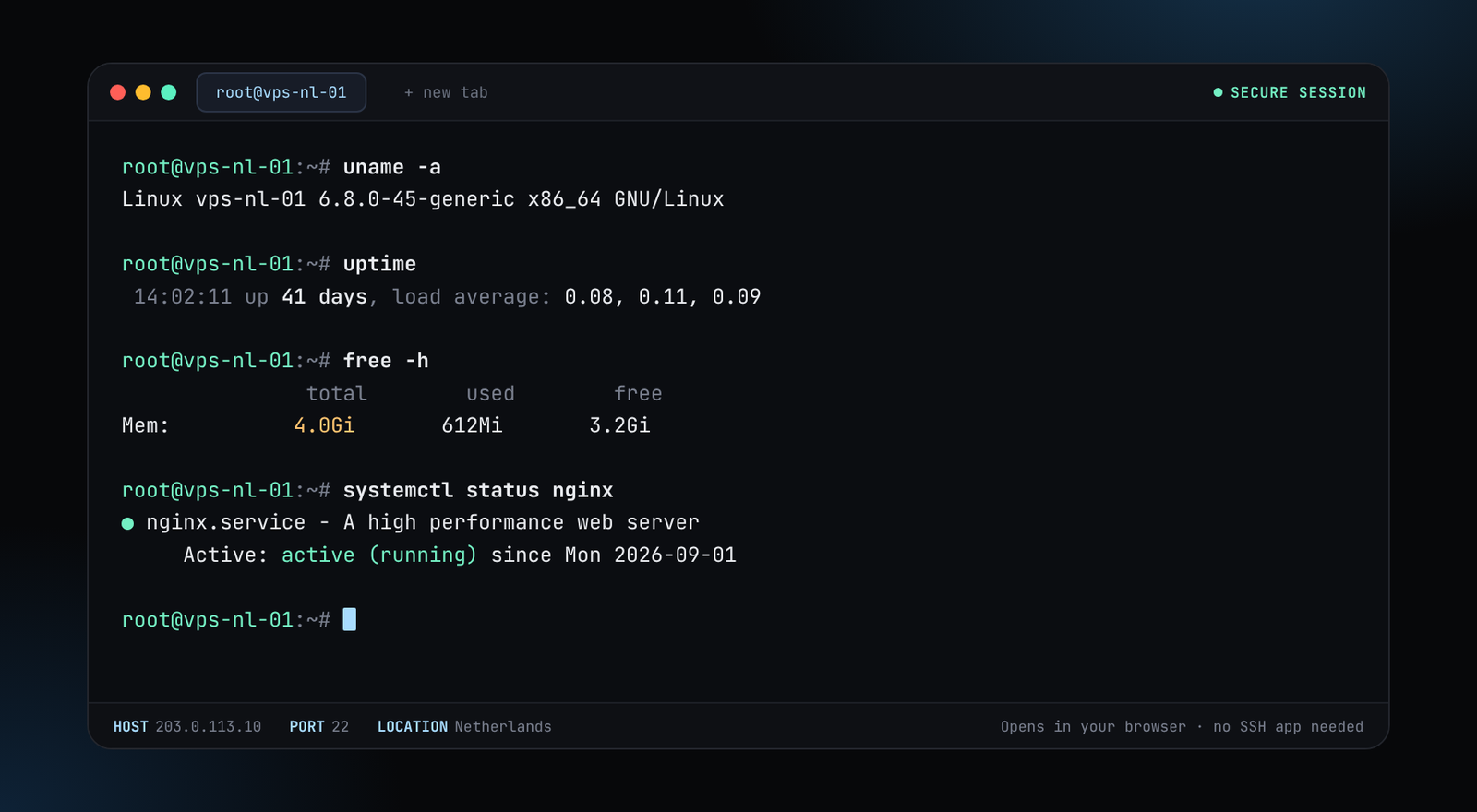
We've got a new update. We now offer our own Web Console. Open the console and type ssh root@your-server-ip to reach any server you own, right from your browser. No SSH app needed.
An Ethereum full node is two programs and well over a terabyte of fast storage. That is more than any VPS disk, so we point you to the right hardware instead of selling you a plan that cannot finish syncing. Dedicated from $82 a month.


Prices are for Romania on a one-month term; a 12-month term takes 50% off.
or $41/mo on a 12-month term (−50%)
The full node needs roughly 1.3 to 1.8 TB. A VPS tops out at 1 TB, so this is a dedicated-server job.
Configure and orderor $70/mo on a 12-month term (−50%)
ECC memory, more cores and four drives: room for a validator client, a metrics stack and a second disk for snapshots.
Configure and orderSince the Merge every Ethereum node runs two clients that talk to each other: an execution client (Geth, Nethermind, Reth, Erigon or Besu) and a consensus client (Lighthouse, Prysm, Teku, Nimbus or Lodestar). Between them a default full node occupies roughly 1.3 to 1.8 TB, depending on the pair, and that figure keeps growing. A 2 TB drive is the floor and 4 TB gives you room for years.
Our VPS plans stop at a 1 TB NVMe disk, so none of them can hold the chain. That is why this page only lists dedicated servers: the $82 Medium has two 2 TB NVMe drives, so the chain fits on one drive with headroom and the other is free for snapshots or a second client.
The $140 Large server has ECC memory and four drives, a layout validators like. Remember what is different about a validator: its keys sign blocks, so a copy of the same keys running on two machines at once can get the validator slashed. Never start a second instance with the same keys, set your withdrawal address on a hardware wallet and keep the signing keys on the server only as long as you must.
| Full node | Validator setup | Archive node | |
|---|---|---|---|
| Disk | 1.3 to 1.8 TB (2 TB floor) | 2 TB plus room for snapshots | 15 TB or more |
| RAM | 16 GB min, 32 GB good | 32 GB or more, ECC preferred | 64 GB or more |
| CPU | 4 cores min, 6 to 8 good | 8 cores or more | 8 cores or more |
| Bandwidth | 1.5 to 3 TB a month | Same, plus uptime matters | Higher |
| Build here | Dedicated Medium | Dedicated Large | Not offered today |
| Price here (Romania, 1 month) | $82 | $140 | n/a |
Disk, RAM, CPU and bandwidth for the full node are from a July 2026 hardware survey. Archive and validator rows are general guidance; client documentation has the exact figures.
One common pairing. Pick any other execution and consensus client pair you prefer; the sizes above hold for all of them. Check flags against the current client documentation.
sudo mkdir -p /var/lib/ethereum/secrets
openssl rand -hex 32 | sudo tee /var/lib/ethereum/secrets/jwt.hexgeth --mainnet --syncmode snap \
--http --http.addr 127.0.0.1 \
--authrpc.addr 127.0.0.1 --authrpc.port 8551 \
--authrpc.jwtsecret /var/lib/ethereum/secrets/jwt.hexlighthouse bn --network mainnet \
--execution-endpoint http://127.0.0.1:8551 \
--execution-jwt /var/lib/ethereum/secrets/jwt.hex \
--checkpoint-sync-url <pick one from eth-clients.github.io/checkpoint-sync-endpoints>sudo ufw allow 30303 # execution peers (TCP and UDP)
sudo ufw allow 9000 # consensus peers (TCP and UDP)
# keep 8545 (JSON-RPC) and 8551 (engine API) closed to the internetA default full node with an execution and a consensus client takes roughly 1.3 to 1.8 TB depending on the pair, according to a July 2026 hardware survey. Buy 2 TB at the very least and 4 TB if you want years of room.
Not on ours: the largest VPS disk is 1 TB, which is less than the chain. A VPS can run a light client, but a full node belongs on a dedicated server with 2 TB or more of NVMe, like the Medium and Large plans on this page.
With good NVMe the initial sync usually takes hours to about a day. A consensus client that uses checkpoint sync is ready in minutes, and the execution client then backfills data. Slow SATA or hard disks may never catch up.
Plan for roughly 1.5 to 3 TB a month. The two servers here have 5 and 10 Gbps ports, so that is not a limit.
Technically yes: a validator client needs a synced node and a steady connection. Staking involves 32 ETH per validator and slashing risk if the same keys run twice, so read your client's staking guide first. We provide the hardware, not staking advice.
No. You create an account with a generated login, top up with ETH, USDT, Bitcoin, Monero or other supported coins and order. See dedicated servers.
Not today. An archive node needs 15 TB or more and our largest dedicated plan has four 4 TB drives. If you need one, tell us through a ticket and we will say honestly whether we can help.
Checked 19 October 2026. Chain sizes and software requirements change, so confirm against the source before you order.
Choose a dedicated server, pay in crypto and get IPMI access. No ID, no card.