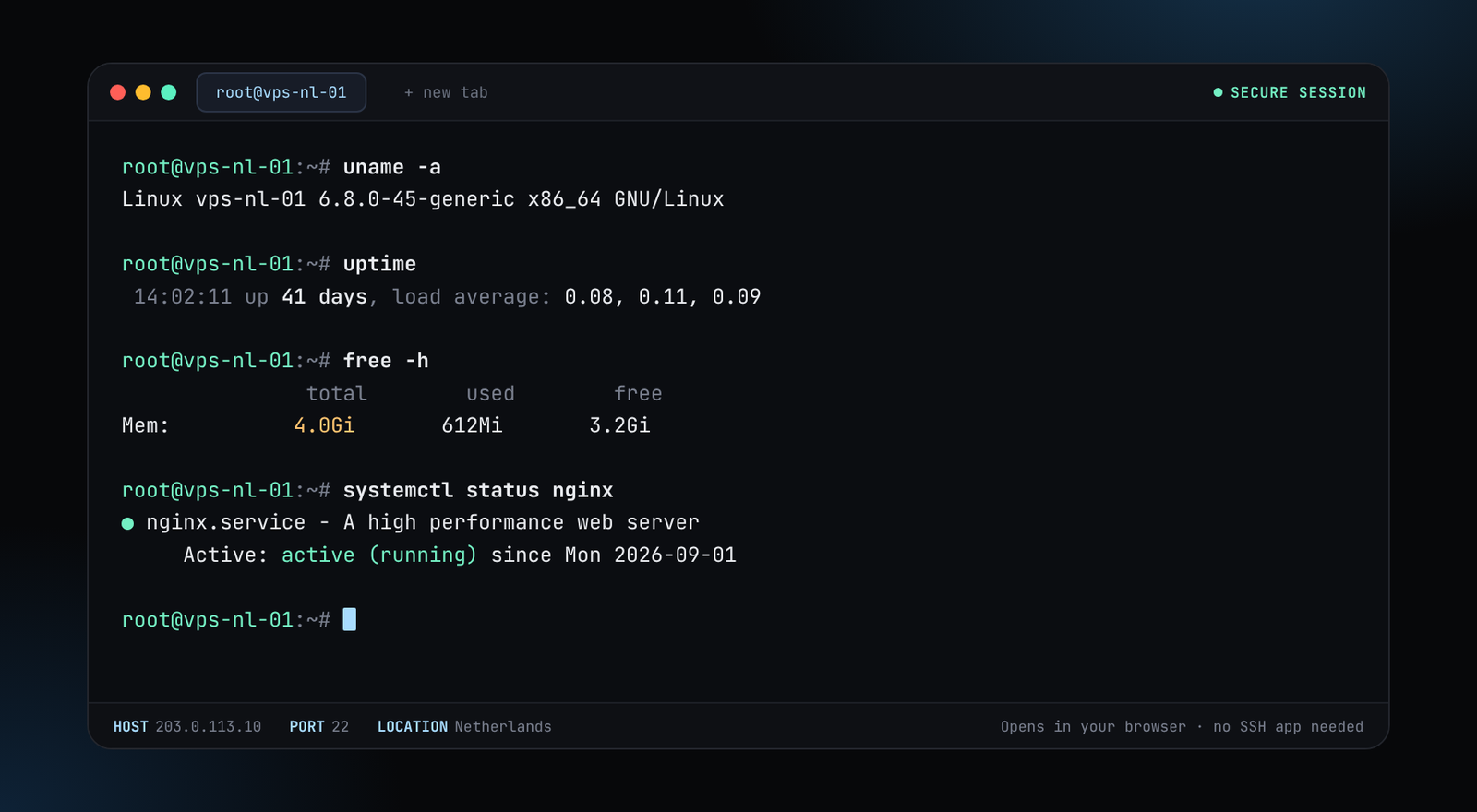
We've got a new update. We now offer our own Web Console. Open the console and type ssh root@your-server-ip to reach any server you own, right from your browser. No SSH app needed.
Practical writing on choosing a jurisdiction, paying with crypto, locking down a server and understanding the rules that still apply wherever you host.
A plain-English guide to no-KYC VPS hosting: what KYC means, what a provider still sees, how payment works, the real risks and a checklist for choosing one.
Renting a VPS without ID is legal in most countries. Here is where the limits are: your own law, the host’s rules, abuse complaints and what no-KYC cannot protect.
Buy a VPS with no ID and a crypto payment: choose a coin, create a generated login, top up, deploy, then harden the server and avoid the mistakes that expose you.
A cheap offshore VPS can be a bargain or a trap. Learn which specs, locations and terms matter at a low price, and the warning signs that mean you should walk away.
Why censors can spot ordinary VPNs, and how to run an Xray VLESS + REALITY endpoint on a private VPS that looks like normal HTTPS traffic.
Run a website as a Tor onion service: install Tor, bind Nginx to localhost, read your .onion address, add client authorisation and avoid the leaks that expose you.
Set up LUKS disk encryption on a rented server: an encrypted data volume, how remote unlock works for the root disk, and an honest threat model.
A CDN hides your server only if nothing else gives it away. Learn how origin IPs leak through DNS history, mail and certificates, and how to lock the origin down.
Install LND on Ubuntu with Bitcoin Core as the backend: config, systemd service, wallet and channel backup, firewall rules and what to protect.
A step-by-step website migration: lower DNS TTL, copy files and the database twice, test with a hosts entry, switch DNS and keep the old server until traffic drains.
Install qBittorrent-nox with a secure web interface, a service user, a firewall and an HTTPS reverse proxy, and learn what bandwidth and disk to rent.
Run an Ethereum execution and consensus client pair on Linux: JWT secret, systemd units, checkpoint sync, ports and what hardware a full node needs.
Connect to a Windows RDP server from macOS with Microsoft's free Windows App: add the server, enter the Administrator login, fix certificate warnings and speed it up.
Self-host BTCPay Server with Docker: server sizing, DNS, the official installer, connecting a wallet, and the backup and security points that matter.
Compare an RTX 4090 or 5090 with an H100 for self-hosted LLM and image inference: memory, bandwidth, cost per token, multi-GPU and when each one wins.
What a Solana validator or RPC node really needs, how to tune the system, start an RPC node with the Agave client and when a smaller option is smarter.
Use Remmina or FreeRDP to reach a Windows RDP server from Ubuntu, Debian, Fedora or Arch, with working commands, useful flags and troubleshooting.
Rent a GPU server, install ComfyUI, load a model, keep the interface private and estimate cost against hosted image services.
The mistakes that identify server operators are rarely technical breaks. They are reused names, linked accounts and logins from home. Here is a checklist.
Install Litecoin Core on Ubuntu or Debian, choose pruned or full, understand MWEB, run it with systemd and open the right ports.
Reach your Windows RDP server from a phone or tablet with Microsoft's free app: add the server, log in as Administrator and make touch control usable.
An honest map of what no-KYC hosting hides, such as your name and ID, and what remains visible: IP addresses, payment trails, DNS and your own habits.
Compare speed, code size, roaming, firewall friendliness and setup effort for self-hosted WireGuard and OpenVPN, with a clear recommendation per use case.
Set up a java-tron FullNode: Java, config, snapshot versus full history, JVM memory, ports and checking that it is synced.
A black screen after connecting to Remote Desktop is usually fixable in minutes: restart the shell, lower client settings, check graphics policy, reboot.
Set up MetaTrader 4 or 5 on a Windows RDP for round-the-clock Expert Advisors: server choice, installation, auto-start, keeping sessions alive and security.
A practical walk-through of paying for hosting with Bitcoin: choosing a wallet, reading the invoice, setting a fee, waiting for confirmations and fixing underpayments.
What pruned, full and archive nodes keep, what each costs in disk space and how to choose for payments, apps, explorers or analytics.
What RDP is, how it works, the port it uses, how it differs from VNC, SSH and a VPS, and what people use an RDP server for.
Install Nginx on Ubuntu, create a server block, add a free Let's Encrypt certificate and speed it up. Copy-and-paste commands for a live site in 20 minutes.
Which jurisdictions have no DMCA-style notice law, where a similar regime applies anyway, and what changes when your content is lawful but disputed.
Host-level DDoS protection stops floods of raw traffic, not clever requests. Add rate limits, caching and bot rules with Nginx and fail2ban to survive application-layer attacks.
Why Litecoin is cheap and fast for hosting payments, how to top up with LTC step by step and the mistakes that cost people money.
Pay for a VPS with USDT: which network to choose, how to top up, how long it takes and the mistakes that lose funds. A stable-price way to pay with crypto.
A and AAAA records, CNAMEs, TTL and propagation, plus how to check that your domain really points at your server and the mistakes to avoid.
SOL or ETH for hosting: speed, fees, the right network, common mistakes and how to choose between them.
Offshore hosting is legal in most countries. What it changes, what it does not, the real risks and how to choose a country sensibly. General information, not legal advice.
Install Docker Engine from the official repository, run it without sudo, launch a first Compose service and avoid the firewall trap that exposes ports.
Compare Bitcoin, Monero, Litecoin, Solana, TRON, BNB and Ethereum on network fees, confirmation time and price stability for hosting payments.
Offshore hosting is a server abroad under local law. Bulletproof hosting promises to ignore complaints. Why the difference matters for reputation, reliability and risk.
Pick the right VPS size, install Java 21, run Minecraft as a systemd service, open the port and protect your server from DDoS attacks.
Add funds with crypto, send the exact amount on the right network, wait for confirmations, order a server and fix common top-up problems.
Register a domain without exposing your details: WHOIS privacy, paying with crypto and a registrar that does not ask for ID. What anonymous can and cannot mean.
Run your own private cloud for files, calendars and contacts: Compose file, HTTPS reverse proxy, trusted domains, cron jobs and backups.
Install Ollama on a GPU server, pull a model, add Open WebUI with Docker, put HTTPS in front and keep your prompts private.
What an offshore VPS actually is, what you gain from hosting outside your home country, what you do not, and when it is worth it.
Get a bot token, write a Python bot, store the token safely and keep it running 24/7 with a systemd service.
Run Bitcoin Core on a VPS: disk, RAM and bandwidth needs, verifying the download, a pruned or full config, a systemd service and firewall rules.
The 3-2-1 rule, what to back up, an encrypted restic setup, a cron script and why you must test a restore. Provider snapshots are not enough.
Create a Discord bot, deploy a discord.js bot on a Linux VPS and keep it online with systemd, with token and intent tips.
Run monerod on a VPS for private wallet access: requirements, verifying the download, pruned mode, restricted RPC and firewall ports.
Volumetric, protocol and application attacks explained, what L3/L4 filtering stops, what it does not, and what to do during an attack.
Run a remote Model Context Protocol server: local versus remote, a Python example, a systemd service, HTTPS with a token and a safety checklist.
A practical way to pick a server location: user latency, the legal framework of the country, connectivity and cost, with notes on ten popular locations.
Run your own Bitwarden-compatible password server: Compose file, hashed admin token, HTTPS, closing sign-ups and a tested backup.
Create an Ed25519 key, copy it to your server, disable password login safely and set up a tidy SSH config. Do this on every new server.
Self-host n8n with Postgres and HTTPS, build an AI agent workflow, protect webhooks and back up the data and encryption key.
NLA, firewall rules for port 3389, account lockout, updates and log checks that keep brute-force bots out of your remote desktop.
Run your own Matrix homeserver with Synapse, PostgreSQL and Docker: config, HTTPS, federation delegation, users and registration.
How crypto payments for hosting work, how Bitcoin and Monero differ for privacy, confirmation times, fees and the mistakes that cost people money.
How each kind of app is deployed on managed web hosting: one-click WordPress, Laravel with Composer, Next.js with Git, plus SSL, domains and email.
Full virtualization versus containers: isolation, kernel access, Docker support, RAM guarantees and how to check what your VPS really runs on.
What each type of hosting is, who it suits, how they compare on control, resources and cost, and how to choose.
Realistic VPS specs for blogs, business sites and WooCommerce by traffic level, what actually uses resources and the caching that matters most.
Starting CPU, RAM and disk for websites, bots, VPNs, Minecraft, Docker apps and pruned nodes, plus commands to check real usage.
How much GPU memory 7B to 70B models need, how to run them with Ollama or vLLM and when renting a GPU beats paying for an API.
Compare Switzerland, the Netherlands, Germany, Romania, Moldova, Finland, the US, Panama, Singapore and Seychelles for law, latency and use case.
No-KYC hosting means you can sign up without handing over identity documents. Here is what that does and does not change about the rules you still follow.
Compare a Windows RDP server and a Linux VPS on software, access, resource use and cost, with a simple way to decide.
A default-deny firewall, fail2ban jails, safer Nginx headers, rate limiting and automatic updates for a VPS that runs a website.
Choose a VPS location by measured latency to the exchange, keep a bot running with systemd and lock down API keys. Not financial advice.
Why running your own mail server is hard, the SPF, DKIM, DMARC and reverse DNS you need, and an easier option for a domain mailbox.
Encrypted, deduplicated backups to a second server: restic and borg commands, database dumps, retention, scheduling and testing a restore.
A copy-and-paste checklist for a fresh Ubuntu or Debian VPS: SSH keys, a non-root user, a firewall, fail2ban, automatic updates and basic monitoring.
What public ledgers reveal, how Monero differs, habits that protect you when paying for hosting and what we collect at signup.
What hosting location changes, what it does not, and a practical checklist for handling personal data wherever your server sits.
Choose the datacenter by the exchange, tune the RDP client and Windows power settings, keep sessions alive and secure the server.
Administrative sessions versus Remote Desktop Services, what CALs are, session limits and how to stay within the rules.
What an offshore domain is, what WHOIS and ICANN rules still apply, how crypto payment helps and how to protect a domain from loss.
Create local users, add them to Remote Desktop Users, check the firewall, manage sessions and understand the limits.
The real differences between a virtual server and bare metal: performance, isolation, price, scaling and the workloads that justify each.
Fees, speed and the mistakes that lose money when you pay for hosting with Tether. How to choose the right network and send the exact amount.
Step-by-step: install WireGuard on Ubuntu or Debian, create keys, write the server and client configs, open the firewall and test the tunnel.
Why some hosts in some countries do not act on US DMCA notices, where that protection ends, and what it can never cover.
Pick a location, pay with crypto and get a server in minutes. No ID needed.