














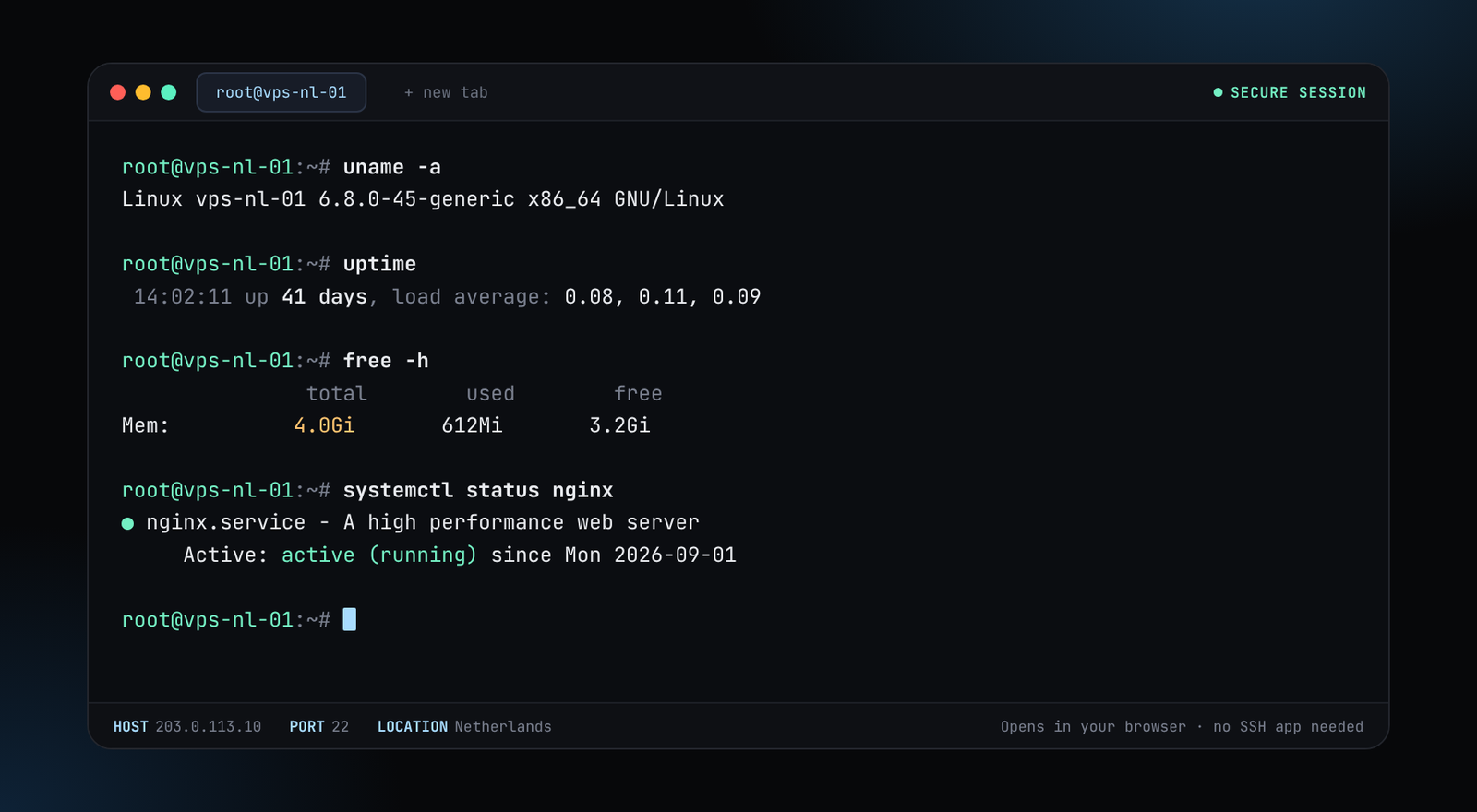
An offshore VPS is a virtual private server that runs in a datacenter outside the country where you live or where your business is registered. It behaves exactly like any other VPS: you get root access, a dedicated slice of CPU, RAM and NVMe storage, and a public IP address. The only thing that changes is which country's laws apply to the machine.
That sounds like a small detail, but it is the whole point. Where a server sits decides which courts can order it seized, which privacy rules govern the data on it, how long a host may be required to keep logs, and how a complaint from another country is handled.
What "offshore" does and does not mean
Offshore does not mean illegal, secret or untouchable. It means the server is hosted under a different legal framework than your home one. People use that for ordinary reasons every day: a freelancer who wants customer data kept out of a jurisdiction with broad surveillance powers, a company that wants servers close to Asian or African customers, a developer who simply prefers not to give a hosting company a scan of their passport.
What you actually gain
- A different legal framework. Some countries have strong data-protection law, some have none at all, and some sit outside the data-sharing treaties that bind their neighbours. You choose the one that matches your needs.
- Lower data exposure. Fewer jurisdictions with automatic access to your data means fewer routes by which it can be requested.
- Geographic reach. A server in Singapore or Seychelles gives you faster response times for users in Asia, the Middle East and East Africa than a server in Frankfurt.
- Optional privacy at signup. Several offshore hosts, including OffshoreVps, accept crypto and do not ask for identity documents. See our guide to no-KYC hosting for what that does and does not change.
What you do not gain
- Immunity from your own country's law. If something is illegal where you live, hosting it elsewhere does not fix that.
- Anonymity by magic. Your traffic, your payment method, your username and your own mistakes can all identify you long before the server's location matters.
- Better performance. A far-away server is a slower server for nearby users. Latency is physics.
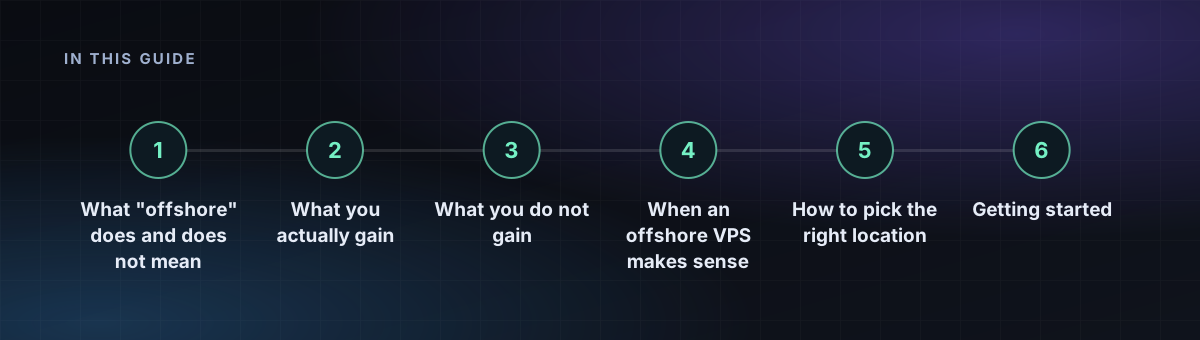
When an offshore VPS makes sense
It is worth considering when at least one of these is true:
- You handle data you would rather keep out of your home jurisdiction, such as a private research project, a community forum or a self-hosted password manager.
- Your users are far from the datacenters your local providers offer.
- You want a pay-as-you-go account that does not need a bank card or personal documents.
- You want to spread infrastructure over several legal environments so one court order cannot reach everything.
It is usually not worth it if your users and your legal obligations are all in one country and you need the lowest possible latency to them. In that case a local provider is simpler.
How to pick the right location
Start with your users, then your legal needs, then price. We cover this step by step in How to Choose a VPS Location, and you can compare all ten of our locations on the locations page. If you are undecided, the jurisdiction selector asks five questions and suggests a country.
Getting started
Deploying one takes a few minutes: choose a location, pick a plan, pay from your account balance and log in over SSH with the image of your choice. The first thing to do afterwards is lock the server down. Our 15-minute hardening checklist walks through it.
Frequently asked questions
What is an offshore VPS?
A virtual private server located in a country other than your own, often chosen for its privacy law, legal process or network position.
Is an offshore VPS faster or slower?
It depends on distance to your visitors. A server near your audience is faster, so choose the location by measuring latency, not by the flag.
Which country is best for an offshore VPS?
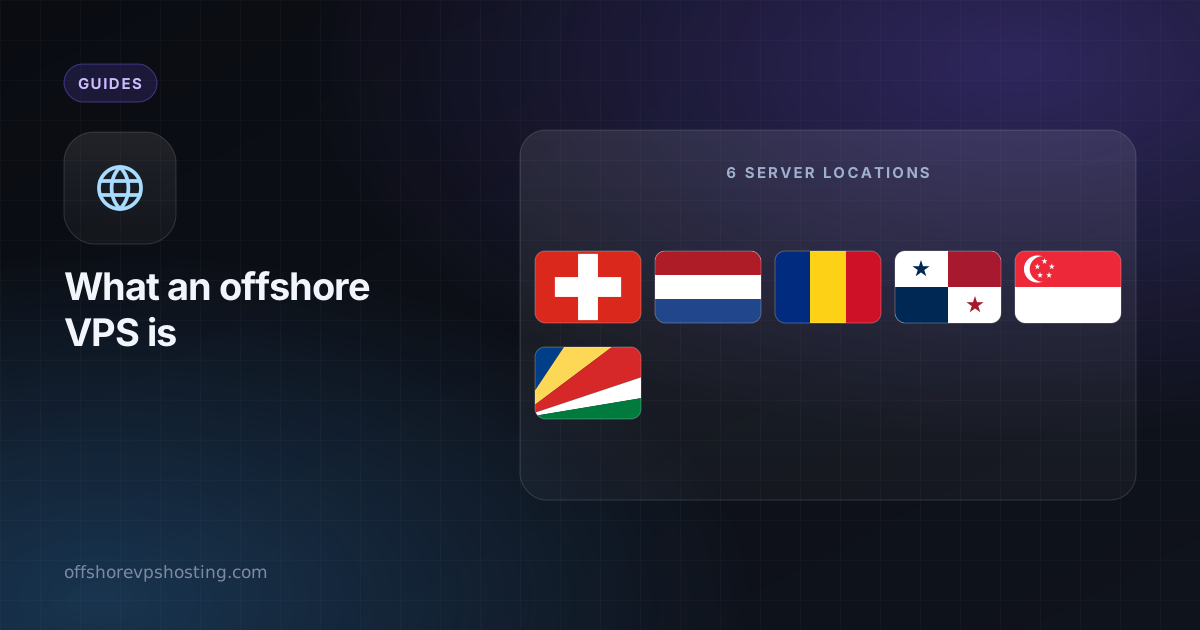
There is no single best country. Switzerland, the Netherlands, Romania, Moldova, Panama, Singapore and others suit different needs; compare them against your content, audience and risk.