








The Digital Millennium Copyright Act is a United States law. A host outside the US is not bound by it directly. That is the whole basis of "DMCA ignored" hosting, and also its limit. Other countries have their own rules, and upstream networks and payment providers often apply their own policies. This is a reality check by country type, not a legal opinion.
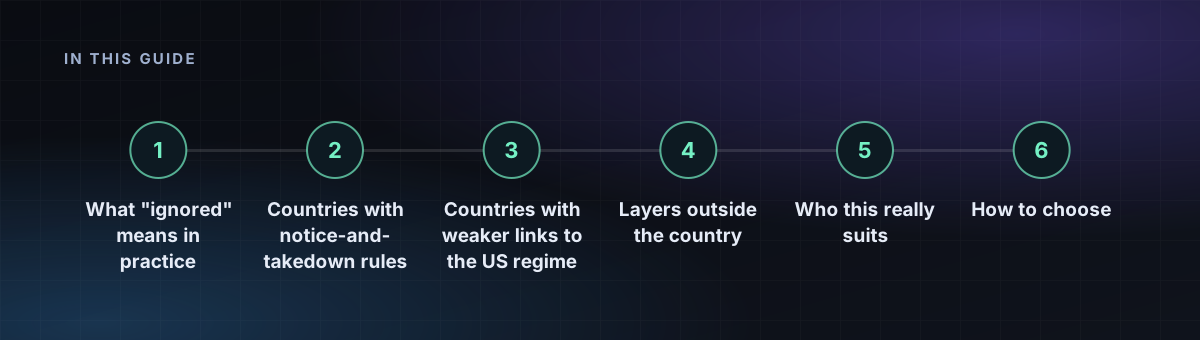
What "ignored" means in practice
A DMCA notice is a US legal tool. A host elsewhere may treat it as a courtesy request, forward it to you and decide what to do under local law. It does not mean "anything is allowed". For the full explanation see what DMCA-ignored hosting means.
Countries with notice-and-takedown rules
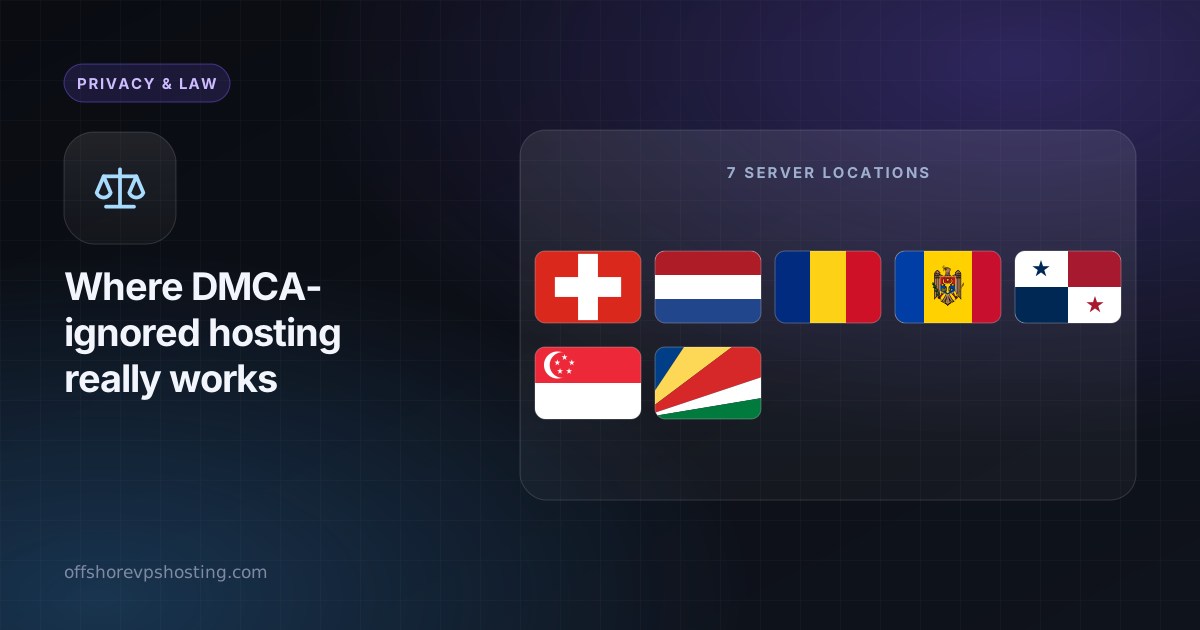
The European Union requires hosts to act on illegal content once notified, under the Digital Services Act and national copyright law. That means a server in the Netherlands, Germany, Romania or Finland is not a place where copyright complaints are simply disregarded. Courts and authorities there can act on valid complaints, and process is orderly and local.
Countries with weaker links to the US regime
Jurisdictions such as Moldova, Panama, the Seychelles and some others do not run a DMCA-style system, and local procedures are slower or different. That can give you more time to respond to a complaint. It does not remove the host's right to end an account under its own terms.
Switzerland and Singapore
Both have strong rule-of-law traditions and clear privacy law. Switzerland has no DMCA-style safe-harbour regime but applies its own copyright law, and Singapore has a formal notice process. Neither is a haven for infringement. Their value is predictability and a stable legal system.
Layers outside the country
- Upstream carriers: your host's network provider may forward complaints and act on them.
- Domain registries and registrars: a domain can be suspended regardless of where the server sits.
- Payment and CDN services: they follow their own rules and the law of the country where they operate.
Who this really suits
- Sites that publish lawful content that attracts false or aggressive complaints.
- Researchers, archives and journalists who value a procedure that goes through a court.
- Businesses that want an orderly response time instead of an immediate shut-off.
It does not suit anyone planning to distribute material they have no right to share. Doing so is unlawful in most countries and a breach of every reputable host's terms.
How to choose
- Write down the kind of complaints you expect.
- Pick a jurisdiction whose procedure fits, using the jurisdiction comparison and choosing a location.
- Read the host's acceptable use policy before paying.
- Keep records of your rights to the content.
Get real legal advice for anything high-stakes. The related legality guide covers the basics.
Frequently asked questions
Which countries ignore DMCA notices?
Most countries outside the US do not apply the DMCA directly, but many have their own notice rules. The EU has notice-and-takedown duties, while places such as Moldova, Panama and the Seychelles use different procedures.
Is DMCA-ignored hosting safe for copyrighted content?
No. It does not protect infringement. It suits lawful content that attracts mistaken or aggressive complaints.