









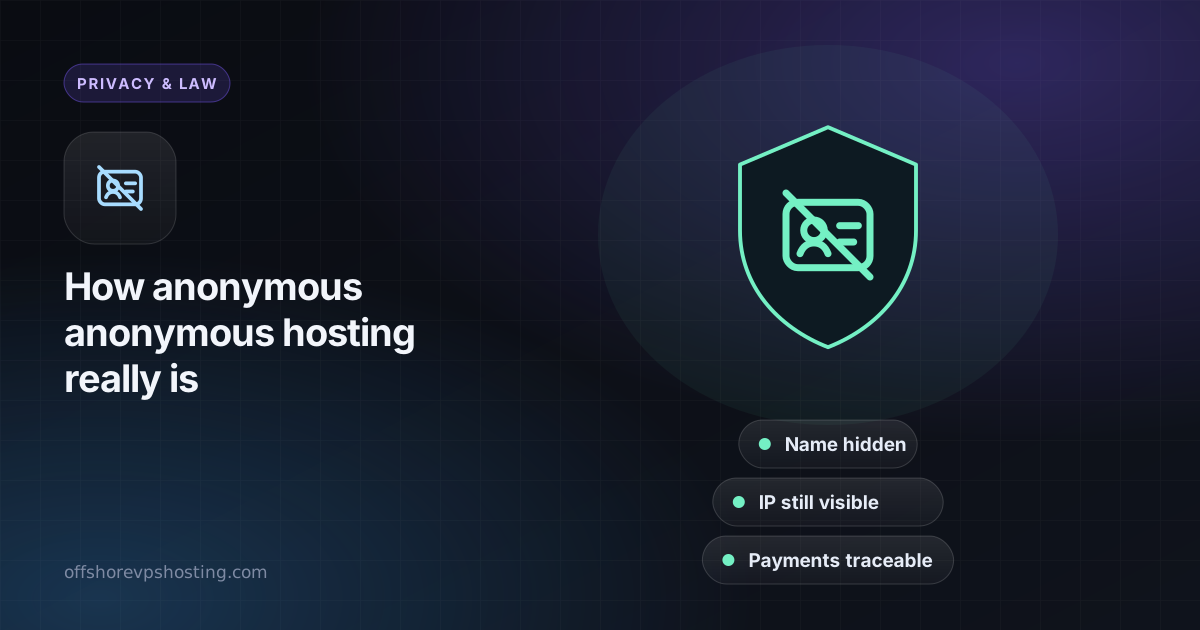
"Anonymous hosting" is a marketing phrase, not a guarantee. What a provider can really offer is narrower: it does not ask for your identity. Everything else depends on how you pay, how you connect and what you publish. Here is a plain map of what is protected and what is not.
What no-KYC hosting actually removes
- No passport, selfie or proof of address at signup.
- No requirement for a personal email address when the login is a generated credential.
- No name on the invoice when you pay in crypto.
That removes the paper trail between you and the account. See no-KYC hosting explained for how it works.
What stays visible
- The server's IP address: every visitor and every scanner sees it.
- Your connection IP: the provider sees where you log in from unless you hide it.
- Payment records: some coins keep a public ledger that anyone can trace.
- DNS and certificates: public data that can tie names to IPs.
- Your content: what you publish identifies you more often than any technical link.
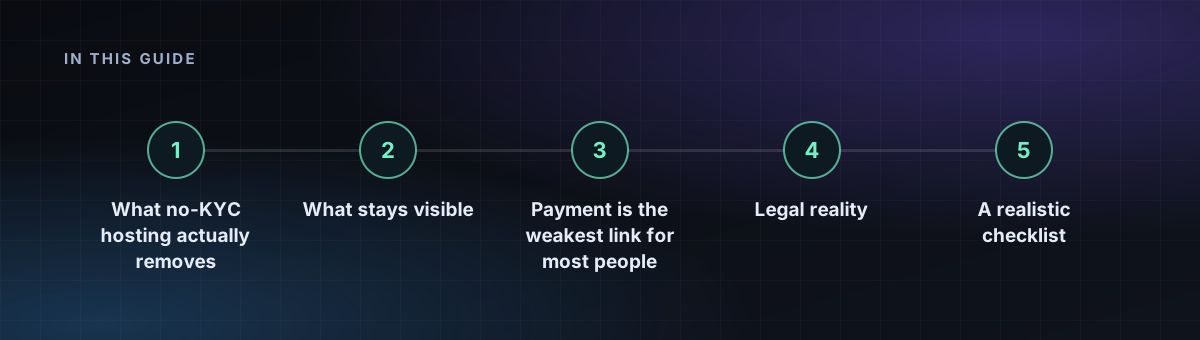
Payment is the weakest link for most people
Bitcoin, Litecoin and USDT are traceable on public chains, and the exchange you bought them from knows your identity. Monero hides amounts and links by default. If privacy matters, plan the payment path from the start, with a look at Bitcoin payments and Bitcoin versus Monero.
Legal reality
A host in any country still answers to its own law and to its upstream network providers. Legal process can reach a provider, and abuse complaints can end an account. Anonymous does not mean unreachable. Read is offshore hosting legal and use the service only for lawful purposes.
A realistic checklist
- Use a generated login and a separate email for any contact.
- Connect through a VPN or Tor, never from your home IP.
- Pay with a coin that matches your threat.
- Keep the domain's WHOIS private, or use none.
- Do not reuse names, passwords or writing styles from elsewhere.
Each step removes one link. Together they make identification hard, but none makes it impossible, and honest providers say so. For the habits side, read server OpSec habits.
Frequently asked questions
Is anonymous hosting really anonymous?
It hides your name and documents from the provider. Your IP address, payment trail, DNS records and habits can still identify you.
What is the weakest link in anonymous hosting?
For most people it is payment: coins with public ledgers can be traced, and exchanges know your identity.
Can an anonymous host be forced to reveal me?
A host can only reveal what it holds. It may still be compelled to act under local law, so lawful use matters.