














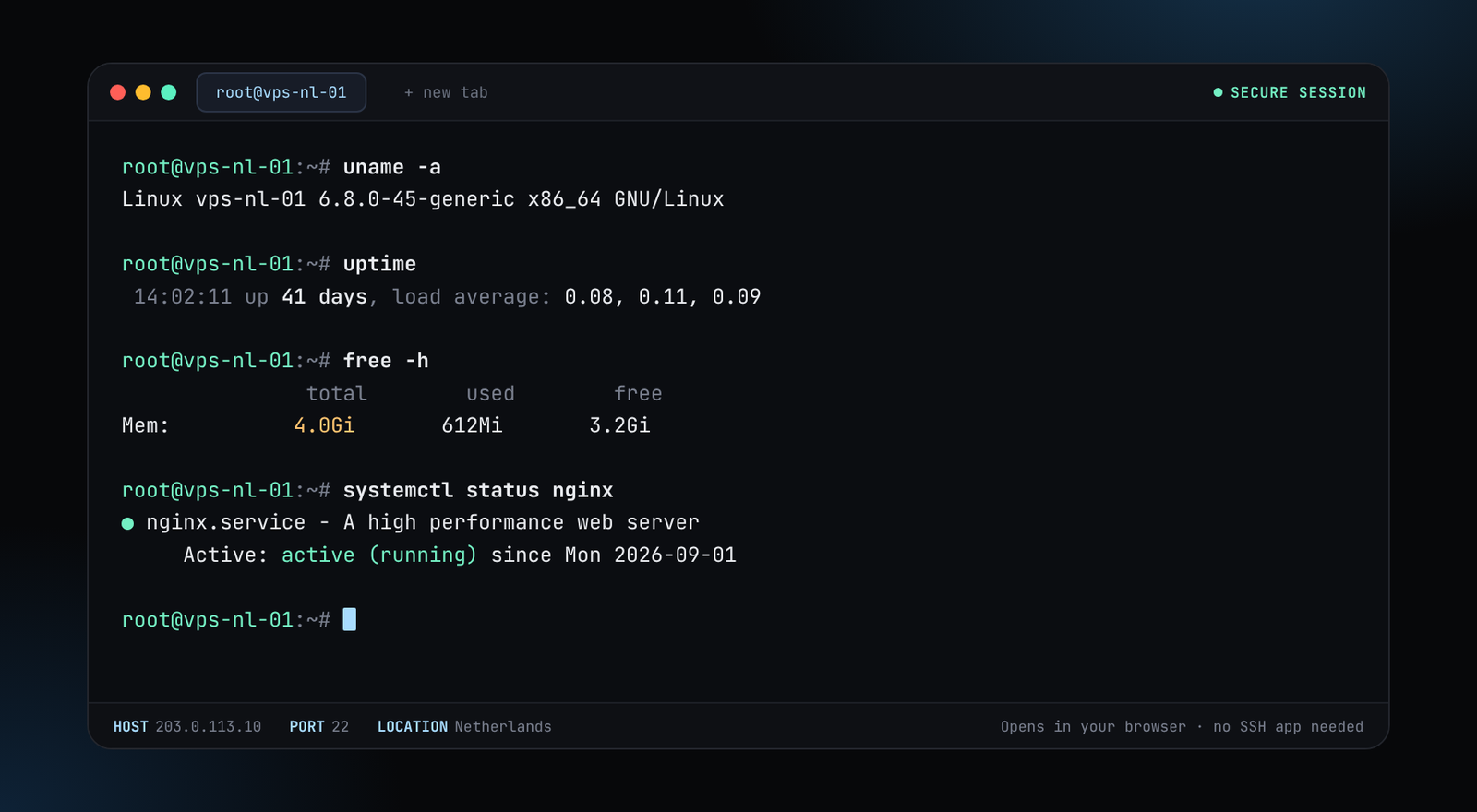
Both give you root access and a public IP. The difference is what sits underneath: a VPS is a slice of a physical machine shared with other virtual servers, while a dedicated server is the whole machine, yours alone. Choosing between them comes down to performance needs, isolation requirements and budget.

The quick comparison
| Factor | VPS | Dedicated server |
|---|---|---|
| Hardware | Virtual slice of a shared host | An entire physical server |
| Performance | Good, can vary with neighbours on busy hosts | Consistent, full access to every core, drive and port |
| Isolation | Separated by the hypervisor (KVM) | Complete physical isolation |
| Setup time | Minutes | Minutes to a few hours |
| Scaling | Resize or add servers quickly | Fixed hardware; scale by adding machines |
| Starting price | Under $10/month | From about $45/month |
| Best for | Websites, apps, bots, VPNs, dev and test | Databases, heavy compute, game hosting, high traffic |
When a VPS is the right call
Most workloads fit comfortably on a VPS. A modern plan with 4 to 8 vCPUs, 8 to 32 GB of RAM and NVMe storage runs a busy website, an API, a database for a small product, a VPN endpoint, a Matrix or email server, a trading bot or a build runner without strain. You also get flexibility: you can deploy a new server in minutes, try a different location, and pay only for what you use.
- You are starting a project and do not know the load yet.
- You want servers in several locations without a large commitment.
- Your workload is bursty, not constantly maxing out the CPU.
- You want to spend a few dollars a month rather than a few dozen.
When a dedicated server earns its price
Dedicated hardware makes sense when you need predictable, sustained performance or full control of the machine.
- Large databases. Terabytes of NVMe across several drives in RAID, with all the RAM you can fit, behave very differently from a shared volume.
- Constant heavy compute. Video encoding, scientific jobs and large builds that run all day get the full machine instead of a share.
- Traffic-heavy services. Streaming, downloads and big APIs benefit from dedicated 5 or 10 Gbps ports.
- Strict isolation. Some projects simply should not share a physical host with anyone else.
- Running your own virtualization. Dedicated hardware lets you run your own hypervisor and sell or split the capacity yourself.

A common path: start small, move up
Many projects follow the same path. They start on a small VPS, grow into a larger VPS, then split services across several VPS machines (web here, database there), and only move the busiest piece to dedicated hardware when measurements show it is the bottleneck. Moving up is straightforward if you keep your setup in scripts or containers from the start.
Questions to ask before you pay more
- Have I measured? Check CPU, memory, disk and network use over a normal week. If you are using 20% of a VPS, a bigger server will not help.
- Is it one bottleneck? If only the database is slow, move or upgrade only that.
- Do I need the location? Hardware is more expensive to relocate than a VPS. Make sure the location is final before you commit.
- Can I tolerate downtime? A single dedicated server is a single point of failure. A pair of cheaper VPS machines in different locations can be more resilient.
See the options
You can compare VPS plans on the VPS page and dedicated tiers on the dedicated page. Both are available in the same ten locations, so you can mix them: a dedicated database server next to a few VPS app servers in the same country.
Frequently asked questions
What is the difference between a VPS and a dedicated server?
A VPS is a virtual slice of a shared machine. A dedicated server is a whole physical machine for you alone.
When should I move from a VPS to a dedicated server?
When you need guaranteed full-machine performance, large disk or memory, custom hardware access, or when sharing a host becomes a bottleneck or a risk.
Is a dedicated server more private?
It removes neighbours on the same hardware, which helps isolation, but the provider still controls the network and data centre.