














The best VPS location is not the one with the most dramatic reputation. It is the one that balances four things: how close it is to your users, the legal framework you want your data under, the quality of its connectivity, and what it costs. Here is a simple way to weigh them.
1. Start with where your users are
Latency is the delay between a request leaving a visitor's browser and the first byte of your reply arriving. Light in fibre covers roughly 200 km per millisecond, and real routes are never straight, so distance matters. As a rough guide:
- Europe to a European server: typically 10 to 40 ms.
- Europe to the US east coast: typically 70 to 110 ms.
- Europe to Singapore: typically 150 to 200 ms or more.
For a static website this barely matters. For SSH sessions, game servers, trading bots, remote desktops and anything chatty, it matters a lot. If your audience is mixed, put the server near the majority or add a CDN in front.
2. Decide which legal framework you want
Every country has its own rules for data protection, lawful access, copyright takedowns and log retention. You do not need to be a lawyer to compare them at a high level, but you should read the notes for your country and ask a qualified professional about anything that matters to you. In broad strokes:
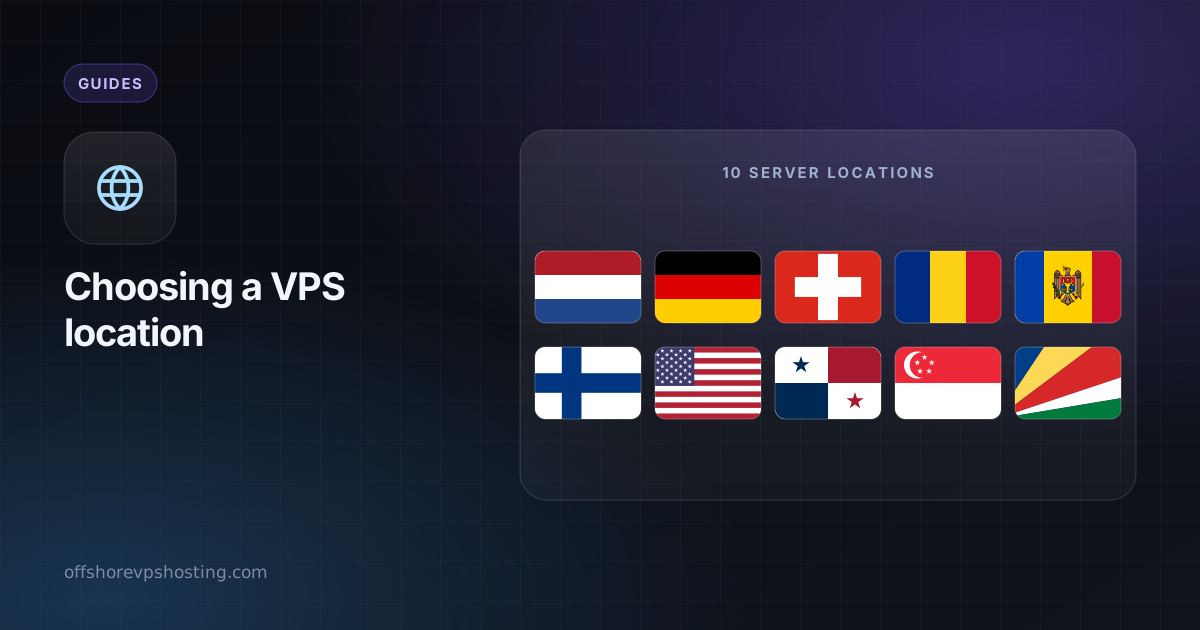
| Location | Typical reason to choose it |
|---|---|
| Netherlands | Best peering in Europe thanks to the Amsterdam exchanges; strong all-round connectivity. |
| Germany | Largest EU market, GDPR framework, Frankfurt and Nuremberg datacenters. |
| Switzerland | Neutral reputation and a modern federal privacy act; premium pricing. |
| Romania | EU member with good regional interconnection at a lower price. |
| Moldova | The lowest prices in our range, with good latency to Eastern Europe. |
| Finland | Cool climate, efficient datacenters and good Nordic connectivity. |
| United States | Three datacenters and extensive peering; best choice for North American users. |
| Panama | Its own data-protection statute and subsea cable landings for Latin America. |
| Singapore | Asia-Pacific hub with low latency across Southeast Asia. |
| Seychelles | Island offshore centre outside EU and US frameworks, good for East Africa and the Indian Ocean. |

3. Check connectivity, not just the map
Two datacenters equally far from your users can feel very different. What matters is how many networks the datacenter peers with and how direct the path is. Hubs like Amsterdam, Frankfurt, Singapore and New York are well connected to everything. Smaller markets can have excellent local routes and a longer path to the rest of the world. Test before you commit: ping the location, run a traceroute, or deploy a small plan for a month and measure from where your users actually are.
4. Compare cost honestly
Price differences between locations are real but modest next to the plan you choose. On our platform the cheapest VPS starts under $6 a month in Moldova, and the premium locations such as Switzerland sit a few dollars higher. Longer billing terms cut the price much more than the location does: 3, 6 and 12 month terms are 25%, 35% and 50% cheaper than paying monthly.
A simple decision recipe
- List where your users are and pick the two nearest locations.
- Remove any location whose legal framework does not suit your project.
- Of what is left, deploy the cheapest small plan in each and measure real latency.
- Keep the winner and cancel the other, or run both for redundancy.
Running in two different countries is also the simplest way to avoid having all your infrastructure under a single legal system.
Frequently asked questions
How do I choose a VPS location?
Pick the region closest to your users or the service you connect to, measure latency with ping or mtr, then consider the legal and privacy rules of the country.
Does VPS location affect SEO?
Only indirectly. Speed matters, so a server near your audience helps. Google does not rank a site higher for being hosted in a specific country.
Can I change my VPS location later?
Usually you order a new server in the new location and migrate. See the guide on moving a website with no downtime.