














Paying for hosting with cryptocurrency is simple once you have done it once, but a few details decide whether it is smooth or expensive. This guide covers how it works, how Bitcoin and Monero differ when privacy matters, and the mistakes worth avoiding.
How crypto top-ups work
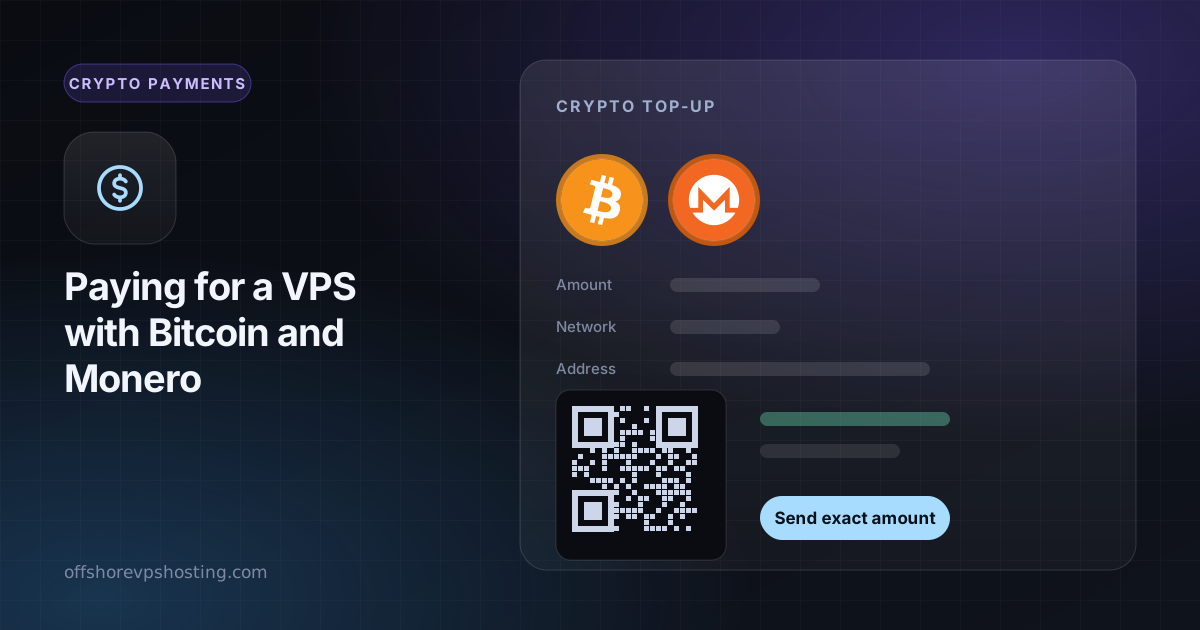
With OffshoreVps you do not pay per invoice. You add funds to your account balance and the balance pays for servers, renewals and domains. The flow is:
- Open the top-up page in your dashboard and choose a coin and an amount.
- You receive a payment address (and often a QR code) valid for that top-up.
- Send the exact amount from your wallet. The balance is credited when the transaction has enough confirmations on the blockchain.
Your balance is then yours to use across every location, so one top-up can fund a VPS in the Netherlands and a renewal in Singapore.
Bitcoin: the default, with trade-offs
Bitcoin is accepted almost everywhere and is easy to buy. For hosting it works well, but remember that the Bitcoin blockchain is public. Every transaction is visible, and if a wallet is ever linked to your identity (for example because it was funded from an exchange account in your name), its history can be traced.
- Speed: one confirmation takes about ten minutes on average, but can take longer when the network is busy.
- Fees: network fees vary with congestion. Check the fee estimate in your wallet before sending.
- Privacy: pseudonymous, not anonymous. Treat it as traceable.
Monero: privacy by design
Monero hides the sender, the receiver and the amount by default using ring signatures, stealth addresses and confidential transactions. For someone who wants payments for hosting to leave as little trace as possible, it is the stronger tool.
- Speed: blocks arrive about every two minutes, and wallets usually require ten confirmations before funds can be spent, so allow around twenty minutes.
- Fees: typically a fraction of a cent.
- Availability: fewer exchanges list it, and some have delisted it, so you may need a peer-to-peer purchase or a swap.
We have a dedicated page on Monero hosting and one on Bitcoin hosting with the supported coins and typical times.
Other coins that work well
Stablecoins such as USDT and USDC are handy when you want to know exactly how many dollars you are sending, since there is no price swing between buying and paying. If you use them, pay attention to which network you send on (TRON, Ethereum, Solana and others each have different fees and addresses). Sending on the wrong network is the most common way to lose a payment.
Mistakes that cost people money
- Wrong network or wrong coin. Always confirm the coin and the network shown on the top-up page match what you send.
- Sending less than required. Exchanges often deduct a withdrawal fee from the amount. Add the fee on top so the full amount arrives.
- Reusing an expired address. Top-up addresses and rates are valid for a limited time. Generate a fresh one if yours expired.
- Impatience. Do not send a second payment because the first has not confirmed yet. Wait for the confirmations and, if it is stuck, contact support with the transaction ID.
Keeping payments as private as you intend
The coin you choose is only one link in the chain. If your wallet was funded from an exchange account that holds your identity documents, the exchange knows what you bought and where you sent it. For stronger separation, people typically combine a privacy coin such as Monero with a wallet they control, and avoid sending from custodial exchange accounts directly to a payment address. Whatever you choose, make sure what you are doing is legal where you live.