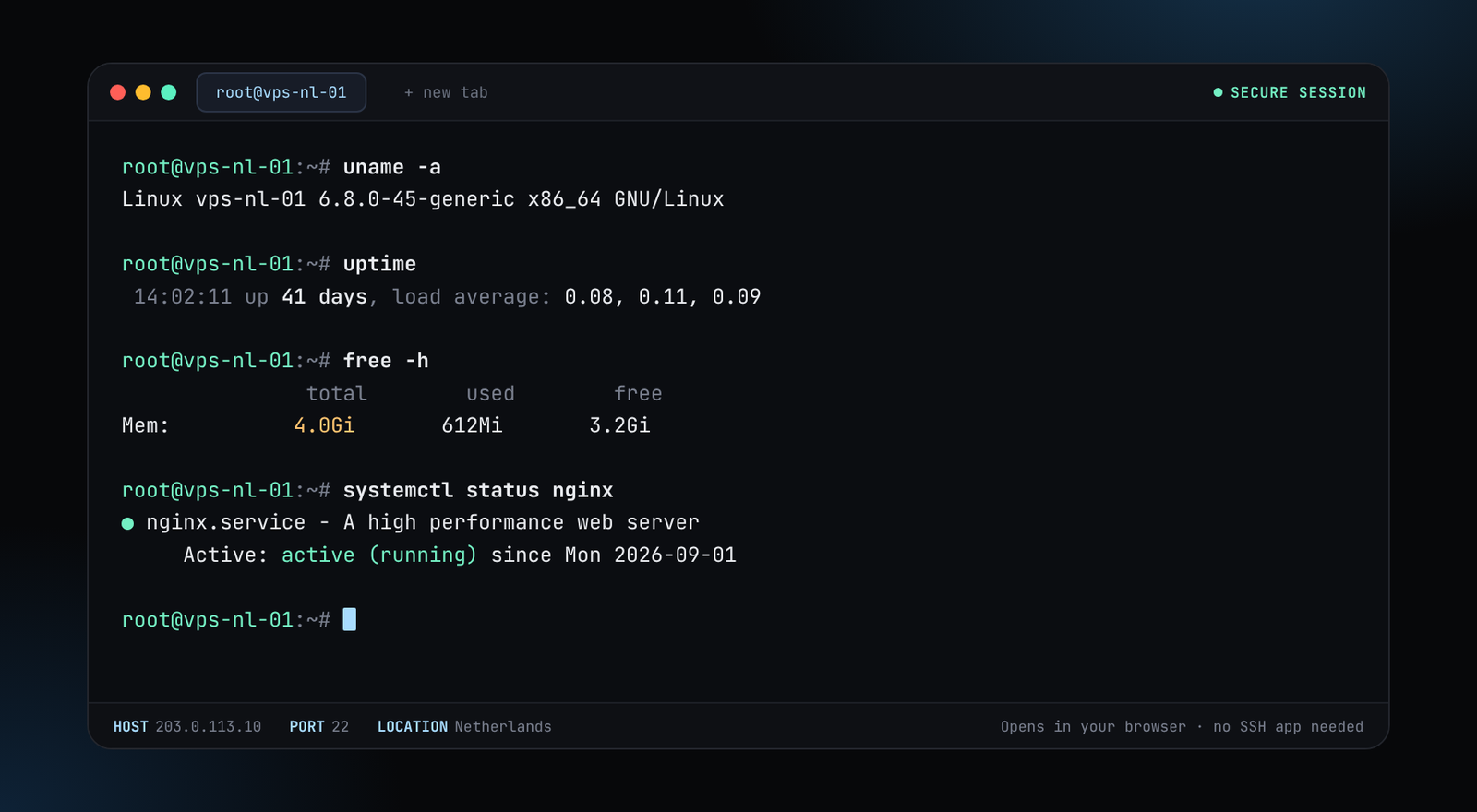
Abbiamo una novità. Ora offriamo la nostra console web. Apri la console e digita ssh root@your-server-ip per raggiungere qualsiasi tuo server direttamente dal browser. Non serve nessuna app SSH.
Offshore hosting means your server sits in a country with a different legal system than yours. Here you pick that country from ten, see its law and its price side by side, and sign up without handing over an identity document.


The legal notes are summaries to help you shortlist, not legal advice. Open a country for its datacenters, full notes and prices.
| Country | Best for | Legal framework in brief | VPS from | Dedicated from |
|---|---|---|---|---|
| Netherlands | Miglior peering | Stato membro dell'UE, quindi si applica il GDPR. Il diritto e i tribunali olandesi regolano l'hosting nel paese. | $6.72 | $49.50 |
| Germany | Mercato centrale dell'UE | Stato membro dell'UE, quindi si applica il GDPR, integrato dalla legge federale tedesca sulla protezione dei dati. Francoforte ospita il DE-CIX, tra i più grandi internet exchange al mondo. | $6.48 | $47.25 |
| Switzerland | Premium | Legge federale sulla protezione dei dati (LPD) riveduta, in vigore da settembre 2023. Fuori dall'UE, con un proprio sistema giuridico. | $8.10 | $58.50 |
| Romania | Membro dell'UE | Stato membro dell'UE, quindi si applica il GDPR. La sua corte costituzionale ha annullato precedenti leggi sulla conservazione dei dati (2009 e 2014). | $6 | $45 |
| Moldova | Regione economica | Non è membro dell'UE, ma è paese candidato che allinea alcune leggi alle norme UE. Le norme sulla protezione dei dati si stanno avvicinando al modello UE. | $5.76 | $42.75 |
| Finland | Regione nordica | Stato membro dell'UE, quindi si applica il GDPR. Il diritto e i tribunali finlandesi regolano l'hosting nel paese. | $6.36 | $47.25 |
| United States | Hub delle Americhe | Si applica il diritto federale statunitense, incluso il processo di notice-and-takedown del DMCA. Le norme sulla privacy variano da stato a stato (per esempio CCPA/CPRA in California). | $6.24 | $45 |
| Panama | Hub delle Americhe | La protezione dei dati è regolata dalla Legge 81 del 2019. Si applicano il diritto e i tribunali panamensi, separati dai sistemi UE e USA. | $6.60 | $47.25 |
| Singapore | Hub APAC | Si applica il Personal Data Protection Act (PDPA). Il diritto e i tribunali di Singapore regolano l'hosting nel paese. | $7.32 | $51.75 |
| Seychelles | Hub offshore insulare | La protezione dei dati è regolata dal Data Protection Act 2023 delle Seychelles. Si applicano la legge e i tribunali delle Seychelles, separati dai sistemi UE e USA. | $7.50 | $54 |
Prices are one-month prices from the live catalogue: the cheapest VPS (1 vCPU, 2 GB, 40 GB) and the Small dedicated server. Longer terms take up to 50% off. Laws change; have a lawyer review anything you depend on.
A takedown notice or a legal request about your server goes through the courts and procedures of the country where it sits, not the country where you live.
Some locations apply strict privacy law, such as the GDPR in the EU or the revised Swiss act. Others have lighter rules or their own regimes. You choose the framework your data lives under.
Combined with an account that needs no identity document, there is simply less personal data for a datacenter, a processor or a third party to hold.
Offshore is not free of trade-offs. A server far from your users is slower for them, so the cheap and private choice is not always the fast one. Pick with your visitors in mind.
It is worth being plain about this, because the marketing around offshore hosting often is not.
What it does give you is real: a choice of legal framework, less personal data in other people’s databases, and a payment that does not run through a bank. For many projects that is exactly the point. For the longer version, read is offshore hosting legal?
Put the server on the same continent. Europe covers six of our ten locations, the Americas two, Asia-Pacific one and Africa one.
Strict GDPR (Germany, Netherlands, Finland, Romania), Swiss privacy law, a non-EU framework (Moldova, Panama, Seychelles) or a hub with the best connectivity.
Moldova is the cheapest, Switzerland the most expensive. A 12-month term cuts any price by 50%.
| Offshore with us | Mainstream cloud | |
|---|---|---|
| Sign-up | Generated login, no ID, phone or name | Email and usually a card, sometimes ID checks |
| Payment | Crypto only, prepaid balance | Card or bank, billed after use |
| Where the server sits | One of 10 countries you choose | Regions the provider chooses |
| Who can reach the server | The local courts of that country | Local courts, plus the provider's home country if it is based elsewhere |
| Account recovery | None: save your login | Usually yes, via email or phone |
| Refunds | As account credit | Often to the card |
| SLA with credits | No formal SLA | Usually yes |
A fair comparison lists what you give up as well. We would rather you know before you order.
Offshore hosting is renting a server in a country other than your own, usually one with a different legal framework for data protection and takedown requests. It lets you choose which laws apply to the machine your data lives on.
Yes. Renting a server abroad is lawful in the jurisdictions we operate in. It does not make otherwise illegal activity legal, and you remain responsible for what you run. See is offshore hosting legal?
It depends on what you need. Switzerland is known for strong privacy law, Romania and Moldova for low prices, Germany and the Netherlands for connectivity, Panama and Seychelles for their own legal frameworks. Our jurisdiction selector shortlists by what you care about.
A VPS starts at $5.76 a month in Moldova and dedicated servers at $42.75. See pricing for every plan, the formula behind the VPS price and the 12-month discount.
No. You create an account with a generated login, top up with crypto and deploy. We never ask for a name, ID, selfie, phone number or address.
Offshore hosting is about where the server is and which law applies. "Bulletproof" is a marketing term for providers that promise to ignore complaints. We act on valid legal process and credible abuse reports. See bulletproof vs offshore hosting.
Yes. Many people choose it for privacy or to keep data out of a particular jurisdiction. For a site with visitors in one region, pick a nearby country so latency stays low.
No ID, no card. Pay in crypto and be live in minutes.