













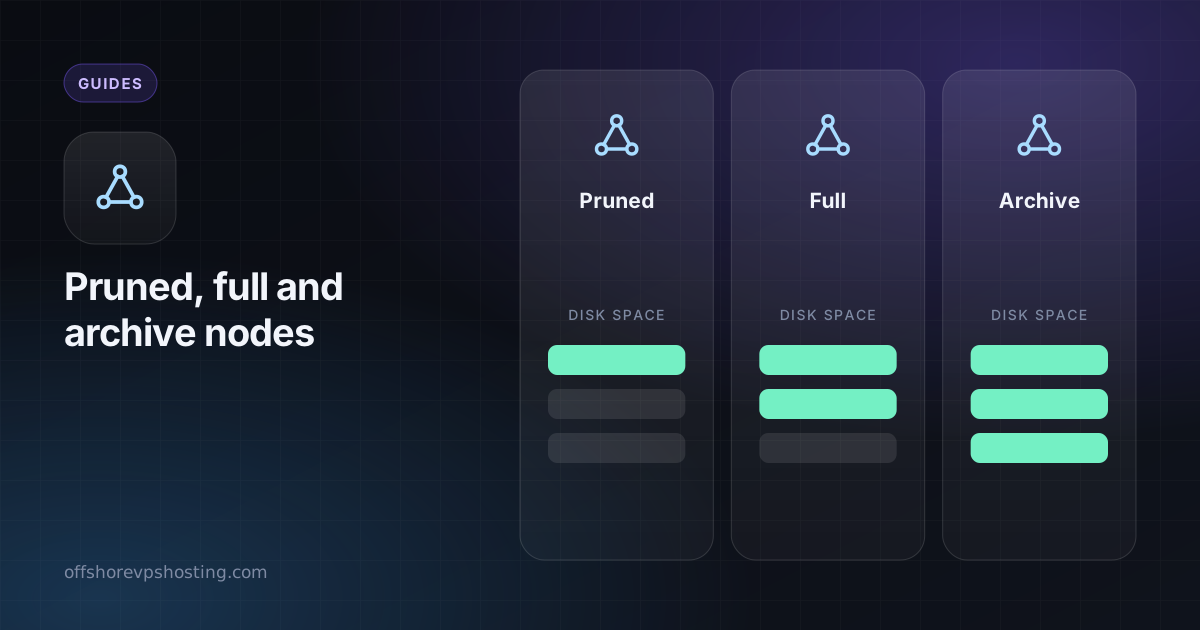
When you set up a blockchain node you will see three words again and again: pruned, full and archive. They describe how much history a node keeps. Choosing the wrong one wastes disk space or leaves you without the data you need. Here is what each one means and how to choose.
The short version
- Pruned node. Verifies every block, then deletes old block data. Small disk. Cannot serve old history.
- Full node. Verifies everything and keeps the whole chain. Can serve any block to peers.
- Archive node. A full node that also keeps every historical state. Needed for old balance and contract queries. Largest disk by far.
What "pruned" does and does not change
A pruned Bitcoin or Litecoin node downloads and checks every block just like a full node, so it enforces the same rules. It then keeps only the most recent blocks (you choose how many). Security for your own wallet is the same. What you lose is the ability to look up old transactions that are not in your wallet and to help new nodes sync from you.
What "archive" means on account-based chains
Chains like Ethereum, BNB Chain and Polygon keep a state tree: balances and contract storage. A normal full node keeps recent state and can rebuild older state if you ask. An archive node stores all past states, so it can answer questions such as "what was this account's balance at block X" instantly. That convenience costs many times the disk of a full node.
How to choose
| You want to... | Use |
|---|---|
| Check your own wallet and payments privately | Pruned (Bitcoin, Litecoin) or full (others) |
| Run a block explorer or analytics | Full with an index, or archive |
| Serve historical state to an app | Archive |
| Help the network and serve peers | Full |
| Keep costs as low as possible | Pruned, or a lite snapshot node |
Disk is the real constraint
Pick the node type first, then choose a server whose disk fits with room to grow. Chain sizes change, so check the client's documentation on the day you buy. On our node hosting page, each chain lists a recommended build for its pruned, full and archive modes.
Next steps
Ready to build one? Start with the guides for Bitcoin, Litecoin, Ethereum or Monero.