














Yes, in almost every country it is legal to rent a server in another country. Offshore hosting is a normal business choice that companies, journalists, developers and individuals make every day. What changes when a server sits abroad is which laws apply to the server, not whether you are allowed to use it. This is general information, not legal advice.
What is legal
- Renting a VPS or dedicated server in a country other than your own.
- Paying a hosting provider with cryptocurrency.
- Signing up without handing over identity documents, where the provider allows it.
- Choosing a location for latency, price or privacy law.
What offshore hosting does not change
- Your own country's law still applies to you. If something is illegal where you live, hosting it abroad does not make it legal.
- The host's rules still apply. Every serious provider forbids malware, phishing, spam and child exploitation, and acts on valid legal process.
- The datacenter country's law applies to the server. A server in Romania follows Romanian law, and one in Switzerland follows Swiss law.
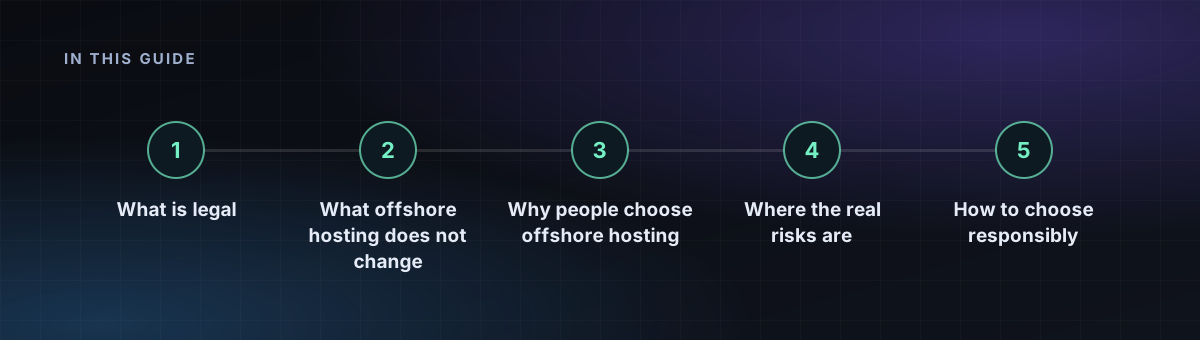
Why people choose offshore hosting
- Data protection. Some countries have strong privacy law and little mandatory data retention.
- Distance from a dispute. A host far from a claimant is harder for a foreign takedown or lawsuit to reach, though this is never absolute.
- Reach. A server closer to your users is simply faster.
- Payment choice. Not everyone has or wants a bank card.
Where the real risks are
- Assuming offshore means untouchable. Courts can reach hosts and individuals across borders through treaties and local orders.
- Hosting content that is illegal in your country. You remain responsible.
- Tax and reporting duties. Running a business from an offshore server does not change where you owe tax.
- Choosing a location by reputation only. Rules change. Check the current position for the country you pick.
How to choose responsibly
Start with what you will host and who your users are. Then compare the legal environment of each location. Our offshore jurisdiction tool asks five questions and suggests where to host, and our locations guide lists laws, datacenters and prices for ten countries. For the basics, read what an offshore VPS is. If the stakes are high, ask a lawyer in your country.
Frequently asked questions
Is offshore hosting legal?
Yes, renting a server in another country is legal in most places. What you run on it must still be lawful where you live, where the server is and where your visitors are.
Does offshore hosting let me ignore the law?
No. A host answers to local law and to its upstream network providers, and your own country can still apply its laws to you. Offshore changes which courts and procedures apply, not whether rules apply.
Why do people choose offshore hosting?
Common reasons are privacy law, a different legal process for complaints, lower latency to a region, and avoiding a single country’s hosting rules for lawful content.