














KYC stands for "know your customer". In hosting it usually means a provider asks for a government ID, a selfie, a proof of address or a payment card in your name before it gives you a server. No-KYC hosting skips that step: you can create an account and deploy a server without handing over identity documents.
What no-KYC changes
- No identity file on you. There is no passport scan or selfie sitting in a provider's database waiting to leak.
- Less data to be requested. A provider cannot hand over documents it never collected.
- Easier signup. No waiting for a manual review, no card needed. With OffshoreVps you get an account with a generated login, no email, and fund it with crypto.
- Access for people who are poorly served by banks. Not everyone has a card, and not every card works internationally.
What no-KYC does not change
- The rules you must follow. Hosting providers still have an acceptable use policy and a legal duty to act on valid legal process in the country where they operate. Abuse such as malware, fraud, spam or content that is illegal in the hosting jurisdiction is still prohibited and can lead to suspension.
- Your own legal obligations. The law of your home country applies to you whether or not a host asked who you are.
- Technical traces. Your IP address, your payment trail and how you configure the server can all identify you. No-KYC removes one source of identification, not all of them.
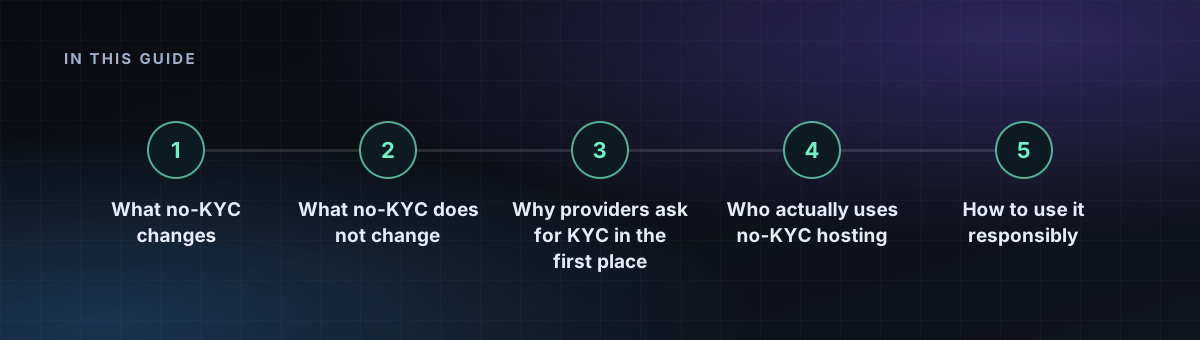
Why providers ask for KYC in the first place
Identity checks are mainly used to fight fraud and abuse, and to meet payment-processor and banking rules. A card payment already ties a customer to a bank, which is why card-based hosts often skip separate ID checks. Hosts that accept only crypto have no card network involved, so no-KYC is a natural fit. The trade-off is that they usually rely on prepaid balances and strong abuse monitoring instead of identity checks.
Who actually uses no-KYC hosting
Many different people: journalists and researchers, developers testing infrastructure, small businesses in countries with currency controls, privacy-minded people who self-host email or a VPN, and anyone who prefers not to put personal documents into yet another company's database. If you are thinking of using it, ask whether the thing you plan to run is lawful where you live and where the server sits.
How to use it responsibly
- Read the provider's terms and acceptable use policy before you deploy.
- Choose a jurisdiction whose rules you have actually read. Our country pages list the main legal notes for each location.
- Keep the server updated and secured. A compromised server used for abuse is your problem, whoever you are. Start with our hardening checklist.
- Keep your own records of what you run. Being able to explain it is the best protection you have.
If you want the product details, see our no-KYC hosting page.
Frequently asked questions
What does no-KYC hosting mean?
KYC stands for know your customer. No-KYC hosting means the provider does not require a passport, selfie or proof of address to open an account. It does not mean the service is exempt from the law or from abuse rules.
Is no-KYC hosting legal?
Yes. In most countries no law requires a hosting company to collect identity documents. You remain responsible for what you run and for following the law where you live.
Is no-KYC hosting fully anonymous?
No. It removes the identity paperwork, but your IP address, payment trail, domain records and own habits can still identify you. See the post on how anonymous anonymous hosting really is.